
From Quantum Anxiety to Market Maturity
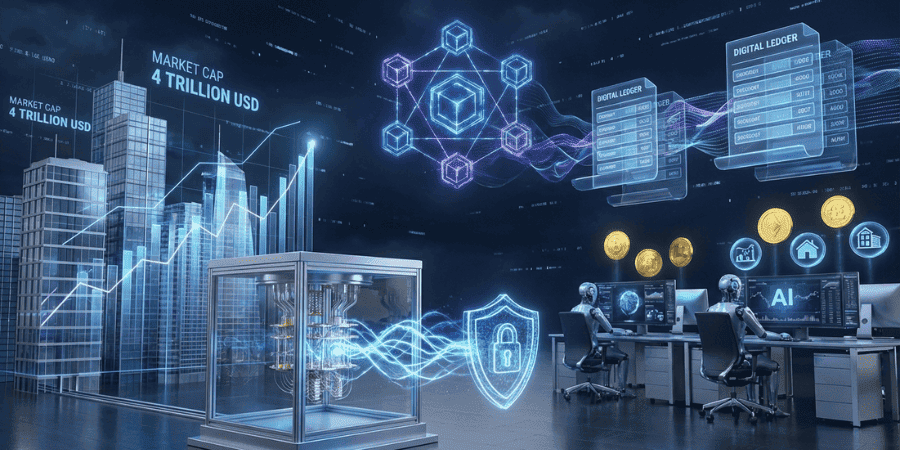
When people ask me what is driving the Current Transition in Crypto, I usually begin with the broader Market context and the deeper structural shifts taking place behind the scenes. A recent report highlighted that by 2025, the total crypto market cap crossed US$ 4 trillion, clearly underscoring the move from a niche asset class toward more mainstream infrastructure.
The industry is becoming increasingly large and institutional. I have seen firsthand how Regulatory and infrastructure developments are playing a growing role, especially through changing custody, deeper tokenization of real-world assets, and increased awareness of compliance and risk.
Yet volatility remains high. The market often responds sharply to risk-signals — from cryptography risks and regulation to broader macroeconomic factors. More than one commentary has pointed to a decline in short-term confidence, often tied to emerging concerns.
Recently, the Quantum-computing new narrative has added another dimension. Vitalik Buterin warned that elliptic-curve cryptography, used by most major blockchains today, could be broken by quantum computers around 2028.
Technical research confirms the threat is real. The industry no longer treats it as a distant or purely theoretical concern for blockchain security. However, it is not an imminent crisis for mining or consensus in the strict sense. One source argues that to challenge mining rigs would require enormous scale and extreme energy inefficiency.
Still, this quantum-risk introduces a new layer of uncertainty. Many investors now worry not only about DeFi implosions, but also about deeper technical vulnerabilities. These are among the potential explanations for prices remaining subdued and effectively keeping down.
Breaking Down the Quantum Security Question
The Quantum Threat Explained simply starts with one question: what exactly is at risk? Most blockchains, including Bitcoin and Ethereum, rely on public-key cryptography, especially elliptic-curve digital signatures, to ensure that only the owner of a private key can sign transactions.
A sufficiently powerful computer could, in theory, derive that key and break the underlying cryptographic assumption. One estimate from a consulting firm suggests that currently about 25% of circulating coins are held in addresses with exposed keys, making them vulnerable to a future attack.
That said, such an attack is not likely soon. Researchers point out that quantum systems are still in an early stage, and real practical capability may be years away. Still, recent statements from Buterin show the community is taking the issue seriously, with 2028 often cited as a commonly quoted horizon.
The broader transition toward quantum-safe standards — often called post-quantum or PQC — is already underway in other fields, including the classical internet infrastructure, though it remains nascent for many blockchain systems.
So, the threat is not immediate. No one expects quantum hackers to break networks today. Instead, it represents a medium-term structural issue that warrants advance planning.
Inside the ecosystem, real work is already doing progress. Blockchain communities are actively discussing migration paths. Ethereum has multiple EIPs (Improvement Proposals) under consideration, including a hybrid approach toward PQC signatures.
Some specialized chains are explicitly quantum-resistant. For example, Quantum Resistant Ledger (QRL) is designed around post-quantum cryptographic algorithms. From my professional experience, Cybersecurity firms consistently emphasise that the longer institutions delay, the higher the cost and likelihood of a breach.
That is why Transitioning toward quantum-resistance may require time, expense, and careful coordination. Markets appear to be discounting this reality as the ecosystem grows and risk-mitigation expectations rise. Any unclear roadmap can quickly dampen appetite until concerns are resolved, particularly while regulatory frameworks remain still evolving, where added risks may compound uncertainty.
Strategic Signals for the Next Phase
Looking at Future Expectations and what to Watch, several Key growth vectors stand out. Continued institutional adoption appears likely as the ecosystem matures. I expect more professional trading desks, secure custody solutions, expanded tokenization of real-world assets and RWA, and deeper integration into global financial infrastructure.
The Convergence of crypto with AI and other tech is accelerating. Various Reports suggest AI-driven agents and programmable frameworks will become more prominent moving forward. Greater Regulatory clarity should gradually improve as frameworks become clearer across the U.S. and globally, allowing the uncertainty premium to fade and enabling stronger capital flow.
However, several factors could impede this progress. If quantum-computing materialises faster than expected mitigation, it could create a major shock to trust in blockchain security. Fragmentation is another risk if chains adopt different strategies or diverge in timing, potentially harming interoperability and smooth value transfer.
On the macro side, downside pressures remain. Despite technological progress, crypto remains susceptible to economic shocks, shifting inflation dynamics, and regulatory clampdowns.
In Possible scenarios, an Optimistic scenario would see smooth transitions, upgrades completed ahead of major threat developments, adoption continues, RWA tokenization takes off, new use-cases arise, prices rise steadily, and overall volatility reduces somewhat.
A Base case assumes quantum risk stays in the background, infrastructure upgrades proceed unevenly, and regulation improves slowly. Markets may recover, but crypto likely stays a high, high reward space.
In a Pessimistic outcome, a real quantum-attack, significant cryptographic failure, or credible near-term disruption occurs. Confidence drops, capital falters, investors flees, value resets, and mining and consensus networks see structural stress.
In the near term, I personally monitor official Announcements and measurable progress from major projects migrating to new signature schemes. I also track Institutional flows — how much funds large investors are putting into infrastructure rather than purely short-term speculation.
Beyond that, I follow regulatory developments, including new laws and guidelines affecting digital assets and stablecoins. I pay close attention to quantum breakthroughs, academic research, rising qubit-counts, and quantum-related public announcements that could materially reduce the timeline toward attack-capable machines.
Above all, I observe overall Market sentiment — how it reacts to technical risk vs. broader macro and regulation concerns. If you are happy to discuss, feel free to leave a comment and let’s talk.